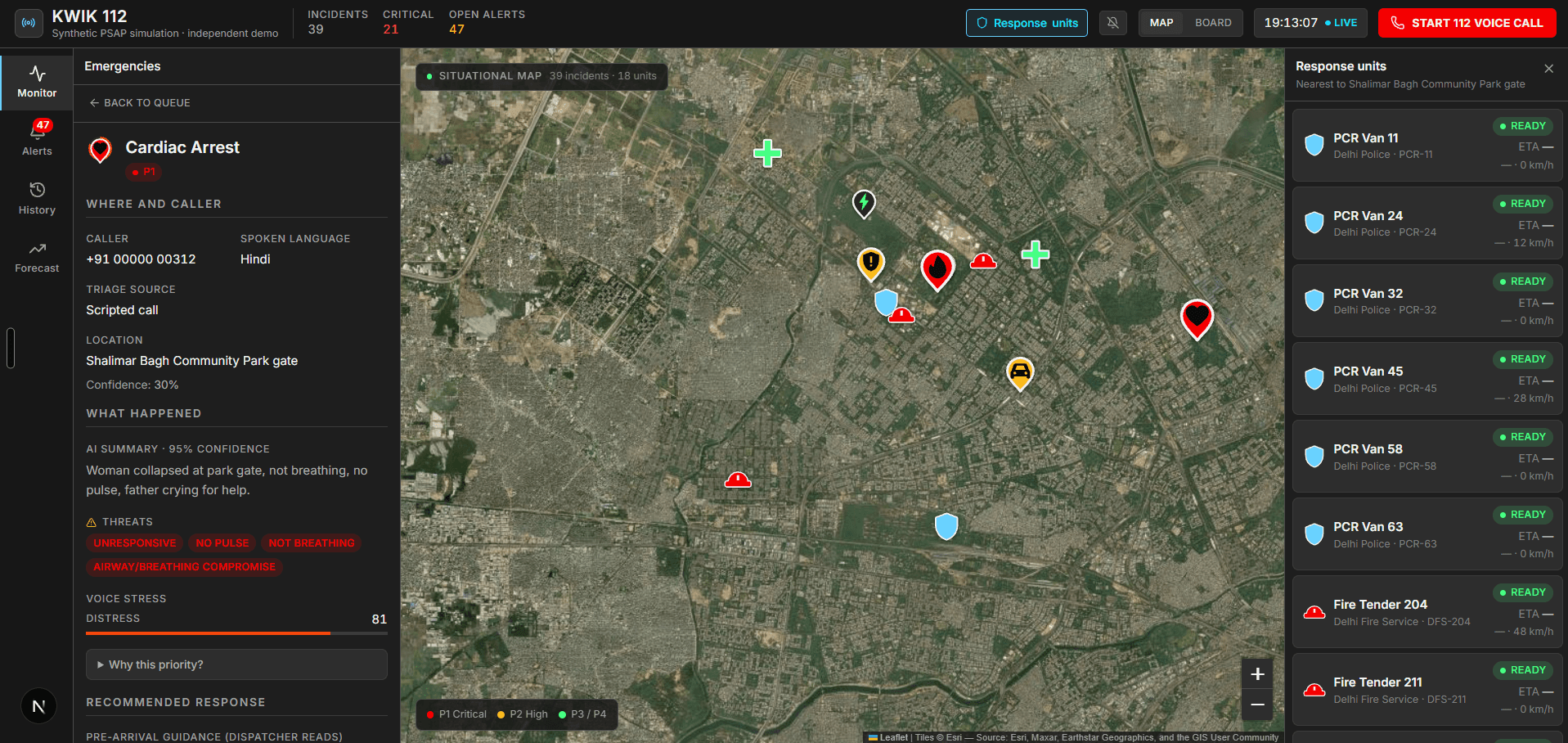
Live emergency simulation
KWIK 112
Use the ring time.
Prepare the human response.
Proposed middleware for the 112 queue. Hindi, Hinglish, and English intake; a safety floor the model cannot lower. The citizen would dial from a keypad phone on 2G—no app, URL, or reading. This browser demo emulates that call.
Built on the AssemblyAI Voice Agent API; optional severity refinement runs through the AssemblyAI LLM Gateway. Independent synthetic demonstration, not an official 112 service.
Measured, not implied
Safety starts before dispatch.
- Critical recall
- 100%
- Threat detection
- 100%
- Local triage latency
- 0.042 ms
9/9 held-out cases · Wilson 95% LB 0.70
3 of 3 held-out cases
Median on the benchmark
Development regression suite, 30 synthetic calls: 100% critical recall (9/9) — no critical call missed — with location text 100% (25/25). The full case-level breakdown, including type/severity accuracy and under- and over-triage, is published unedited. Local p95 5.219ms; timings exclude providers and vary by run. Inspect the committed results · Raw evidence.
- 0.28% genuine of about 16 lakh daily combined 112/Dial 100 calls in Telangana. 25 June 2026 report.
- Under 15 seconds is the MHA answer-speed target; the reported national response average is about 18 minutes. Different stages, not measured ring time. MHA, 2015, p20; DGP report, 6 August 2026.
- 10,000 of 15,672 daily Delhi calls were reported blank; IVR filtering was already in place. 1 October 2019 report.
- A merged queue: SaveLIFE Foundation v. Union of India, W.P.(C) 726/2024, 2026 INSC 567, ordered six helplines integrated into 112 within three months. The window has closed by calendar inference; implementation is not established here. Order, 26 May 2026.
From call to closure
One operational thread. Six decisions.
Every stage adds context without taking control away from the dispatcher.
- 01
Receive
A caller speaks naturally in Hindi, Hinglish, or English.
- 02
Understand
Transcript, location, injuries, and voice cues reach the desk.
- 03
Grade
Deterministic rules assign an immediate safety-first priority.
- 04
Refine
Model review may escalate severity, but never downgrade it.
- 05
Dispatch
A human selects the response and sends units en route.
- 06
Audit
Evidence, overrides, units, and decisions remain traceable.
Three scripted calls
Hear the pressure. Watch the incident form.
Each scripted performance carries a distinct language and emergency through the incident pipeline. Its emotion frames are simulated; live calls run on the AssemblyAI Voice Agent API. Fleet and ETAs are synthetic.
Open voice stationBuilt for scrutiny
Conservative by code. Accountable by design.
Deterministic triage sets a safety floor. A calm report of no pulse remains critical. Emotion stays within its severity band; possible prank cues are annotations, never automatic rejection. Humans record INTAKE, DISPATCH, and RESOLUTION; overrides need notes. The browser-local audit persists until storage is cleared.
- 30 held-out synthetic calls
- 0 autonomous dispatch decisions
- 1 auditable incident timeline
The fastest way to understand it
Place the call. See the response.
Independent simulation. Not an official 112, ERSS, government, or C-DAC service. It does not connect to emergency infrastructure. Safety context